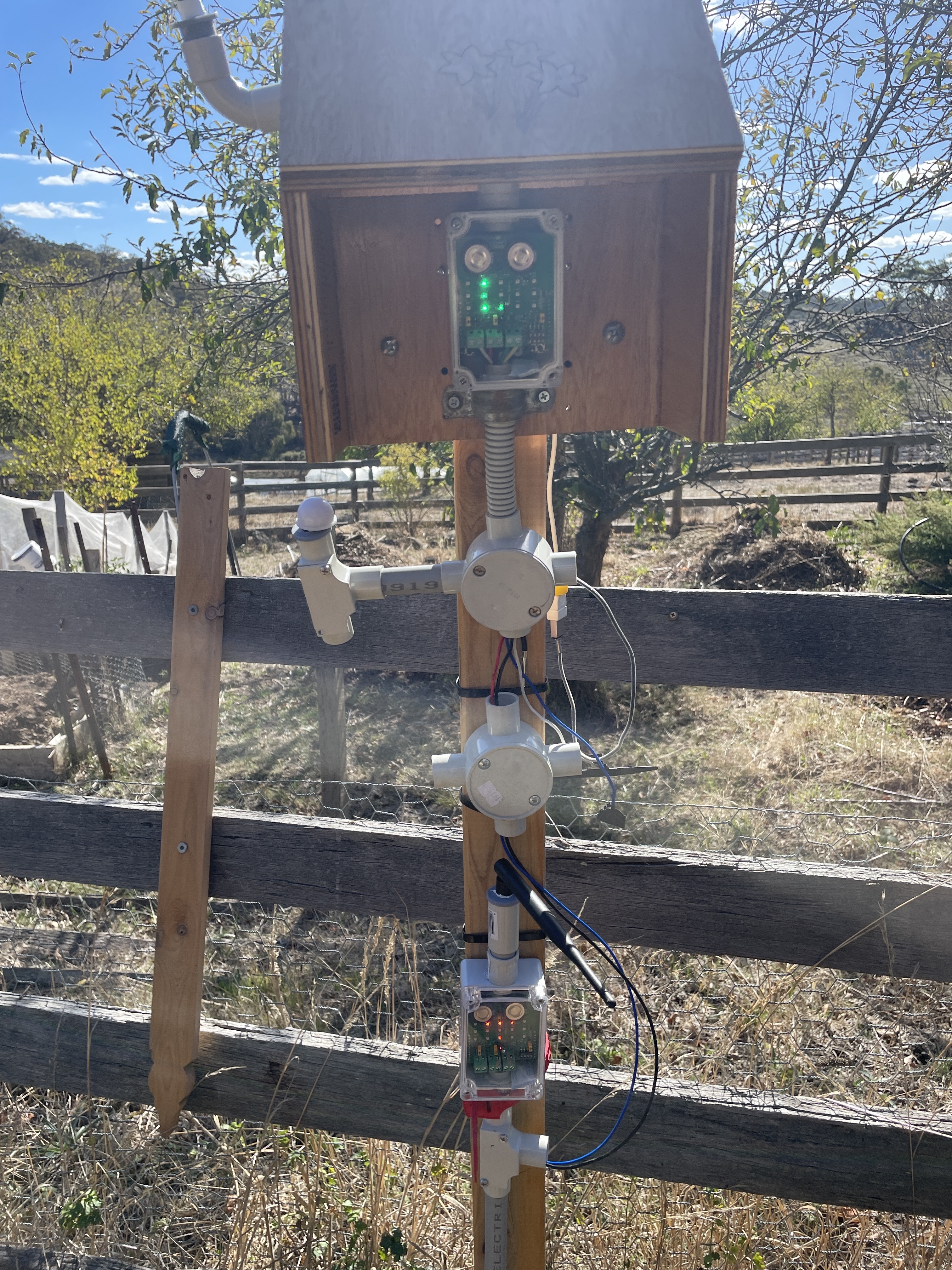
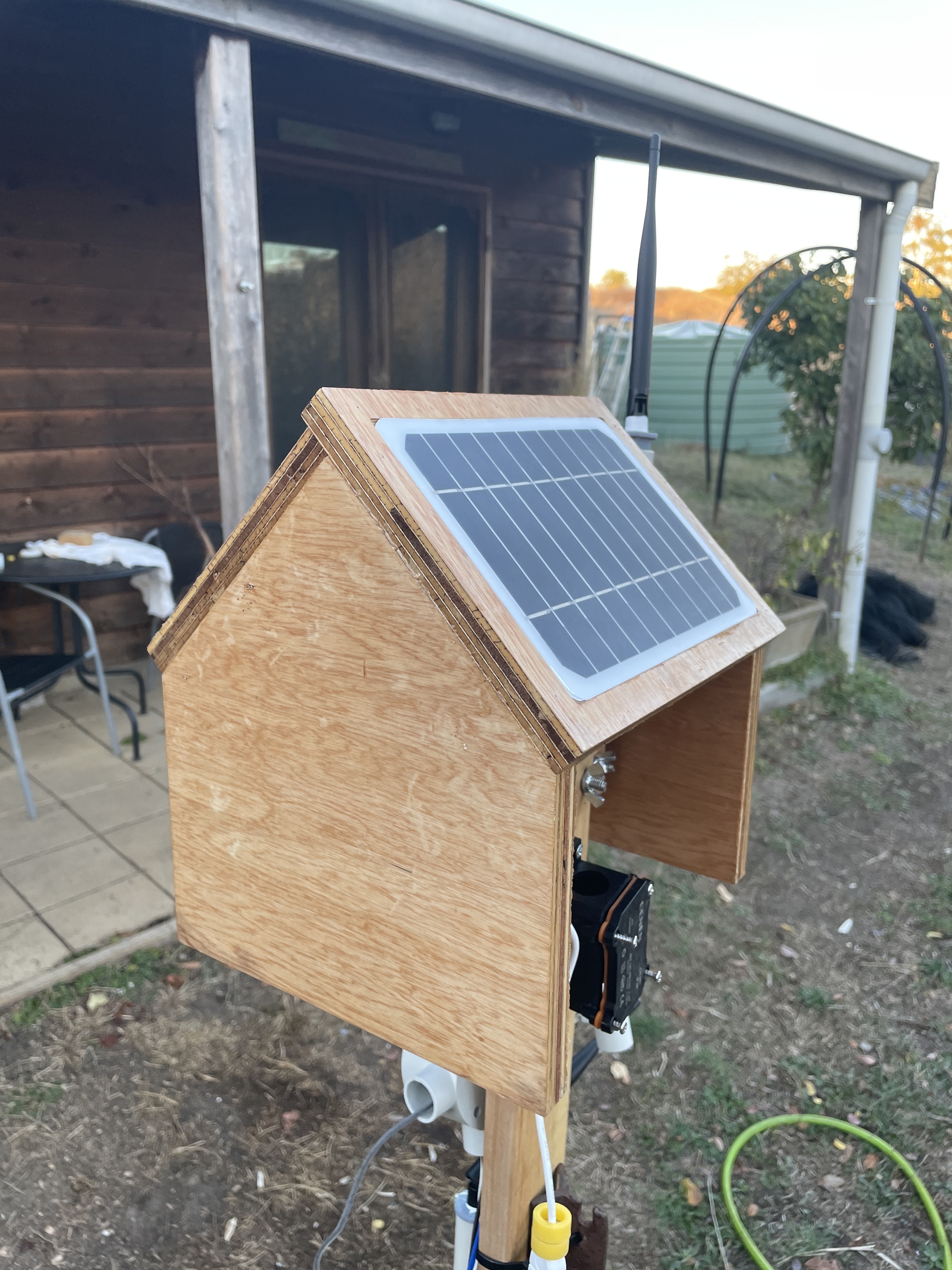
The swiss army knife of farm electronics. Daffodil monitors water troughs,
septic tanks, flow meters, and environmental conditions — reporting back to the Digital Stables
cloud over WiFi. Comes with a 10W solar panel that connects via USB, and is also ready for
standard wall power — deploy it anywhere in the field or the shed.
Works with Annabelle —
Through Annabelle, Daffodil receives hourly weather forecasts over LoRa and uses them to manage its power budget intelligently,
conserving battery and adjusting LED brightness during predicted cloudy periods.
Dynamic Sleep — Using the onboard RTC and GPS-configured coordinates,
Daffodil dynamically calculates sunrise and sunset for your exact location and season.
Right after sunset it wakes roughly every 7–8 minutes; as night deepens the interval
grows longer with no fixed cap; in the 90 minutes before dawn it wakes every 90 seconds — ready to catch
the first moments of solar charging. When voltage drops below 2.8 V the device enters
Coma state — sleep duration is still calculated by the power manager but sensor data
collection is suspended until charge recovers.
The Daffodil shield has a 5-position DIP switch with a resistor network,
read once at power-on. Switches 1–4 select the device's function — what
it measures and reports. Switch 5 is a separate setting, explained
below the table — it doesn't change the function.
SW1SW2SW3SW4SW5
Switch Position
Function
Reporting Mode
Available nowComing soon — hardware in developmentReserved — not yet assigned
About Switch 5 — Reporting Mode
Switch 5 isn't simply "I have a solar panel attached." It's a trade-off between
how often the unit checks in and how long the battery lasts.
ON — Battery Saver:
the unit paces itself against its solar-charging schedule, sleeping more and
reporting less often to trade frequency for battery life. This is the right
setting for most unattended, solar-charged deployments — like checking a trough
water level — where you don't need minute-by-minute updates.
OFF — Frequent Reports:
the unit reports more often and doesn't wait on the solar schedule, giving
closer-to-real-time readings (e.g. active flow monitoring). This uses more
battery, so it's best when the unit has reliable charging or you're comfortable
trading battery life for more frequent data.
Either way, the unit still protects its battery from over-discharging — the
difference is purely about how often it reports, not about battery safety.
The 15 WS2812 LEDs are arranged in 3 rows × 5 columns (index 0–14 left-to-right,
top-to-bottom). On each wake cycle the firmware cycles through 5 display modes.
Color and the number of lit LEDs encode the current sensor value.
The system uses two custom PCBs that stack together.
Wally is the main controller board;
Daffodil is the sensor shield that mounts on top.
Screw terminals for flow meters, ultrasonic, external sensors
Config
Analog resistor ladder switch (32 positions)
Sleep control
Power MOSFET on pin 26
I²C Addresses
Address
Device
0x23
BH1750 Light sensor
0x41
INA219 Current sensor
0x44
SHT Humidity / Temperature
0x48
ADS1115 ADC
0x51
PCF8563T RTC
Operating Modes
Selected at boot via analog config switch on ADS1115 ch2.
Water Trough monitoring
Septic tank level
Flow meter (1 or 2 channels)
Tank level (1 or 2 tanks)
Daffodil uses its onboard RTC (PCF8563T) paired with GPS-configured
latitude and longitude to precisely calculate sunrise and sunset for any day of the year.
Sleep intervals scale automatically with the season — short summer nights get lighter sleep
budgets than long winter nights — ensuring maximum uptime during daylight and minimum power
draw through the quiet hours. The PowerManager library handles all the maths:
sleep_seconds = 450 × night_minutes ÷ minutes_to_sunrise, minimum 90 s with no upper cap.
Daily Power Cycle
Sleep States
State
Condition
Sleep Duration (calculateOptimalSleepTime)
LEDs
Sensor Data
Full Mode #3
Daytime · voltage ≥ 3.28 V · clear sky forecast
Continuously awake
Full brightness (solar-adjusted)
✓ Yes
Cloudy #4
Daytime · cloud forecast ≥70% cloudiness via LoRa or BH1750 lux below cloudy threshold — either source triggers independently
Sleeps between each LoRa cycle · same formula as Night Sleep
Alternates on/off each cycle (50% duty)
✓ Yes
No LED #2
Voltage 3.12–3.18 V — too low for safe LED operation
Continuously awake
Off
✓ Yes
Sleep #1
Night (efficiency ≤ 30%) or voltage < 3.12 V
≥90 s · grows longer as sunrise approaches
Off
✓ Yes
Coma #5
Voltage critically low (< 2.8 V)
calculateOptimalSleepTime() · same formula as Sleep
Off
✗ No
Night sleep formula:sleep_s = 450 × total_night_minutes ÷ minutes_to_sunrise
Minimum 90 s, no upper cap. Melbourne winter examples: ~457 s (7.6 min) at 6 pm ·
~904 s (15 min) at midnight · ~1408 s (23 min) at 3 am —
then pre-dawn kicks in at ≤90 min before sunrise and switches to fixed 90 s intervals.